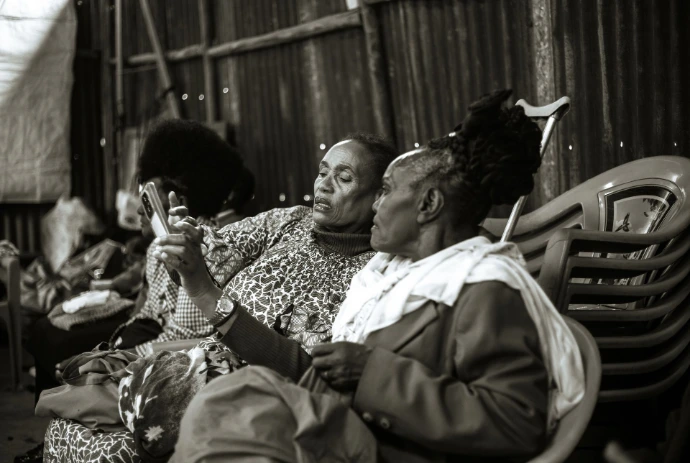
Nywele is a collectible book project by photographer Mutua Matheka exploring African hairstyles and the stories carried through them. The project looks beyond hair as an aesthetic expression, considering it as a language of identity, memory, culture, pride and belonging. Across its different components, Nywele examines how hair has been shaped by history and, in turn, how it continues to shape the ways African people understand and present themselves.
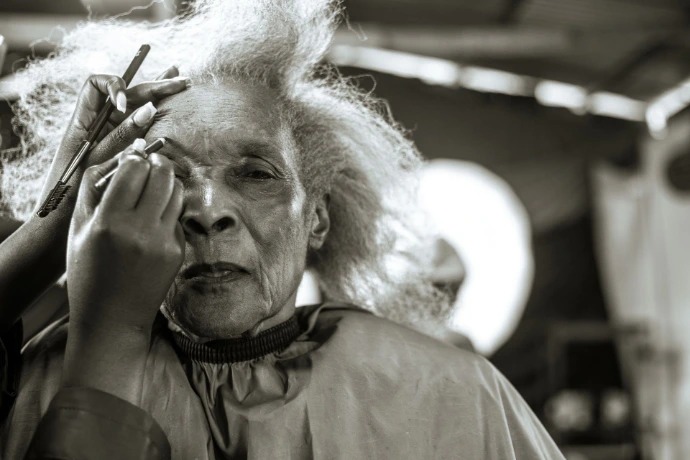
One of these components is Akili ni Nywele, a body of work centred on elders.
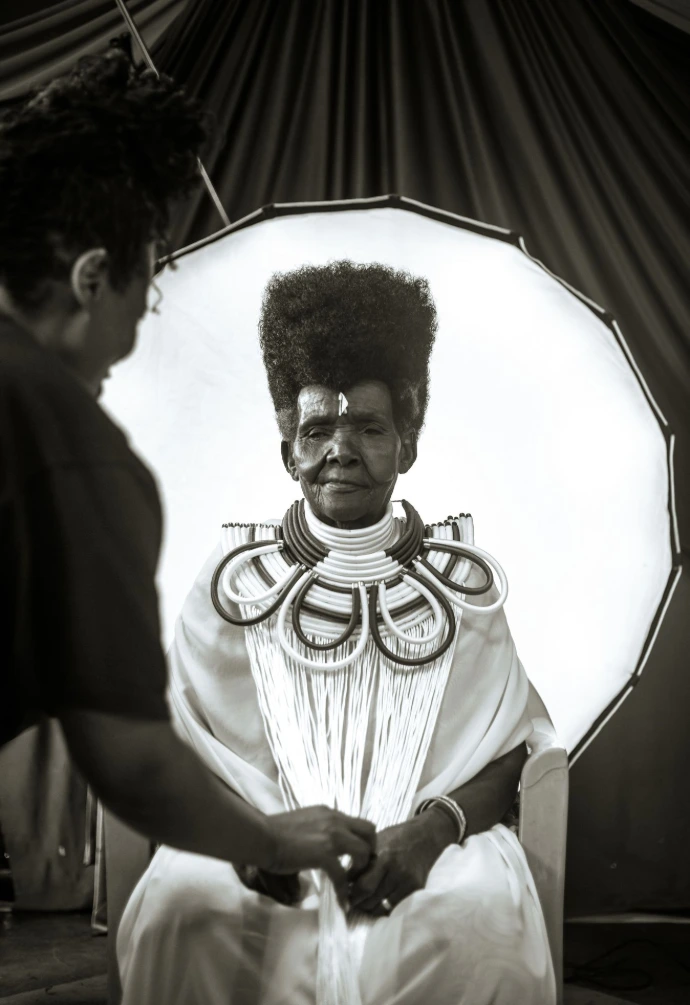
The idea came from a desire to create an opportunity for older people to be seen outside the contexts in which they are usually placed. Matheka was interested in the potential of a generation that is often overlooked within contemporary fashion and visual culture, and in what might emerge when elders were given the opportunity to occupy a very different visual world.
The intention was never to make them appear younger. It was to make them visible differently.
“As an artist, my goal is to transcend the boundaries of the conventional and create something uniquely beautiful.”
That philosophy shaped the way Matheka approached the shoot. His process is instinctive. He may know the image he wants, but he deliberately leaves room to be surprised by what happens in front of the camera. Rather than controlling every element, he focuses on creating an environment in which his subjects can become comfortable enough for something authentic to emerge.
For him, that authenticity is particularly important because the most compelling body language is often the body language that has not been instructed.
A gesture. A particular expression. The way someone sits. A familiar movement. A slight shift in posture.
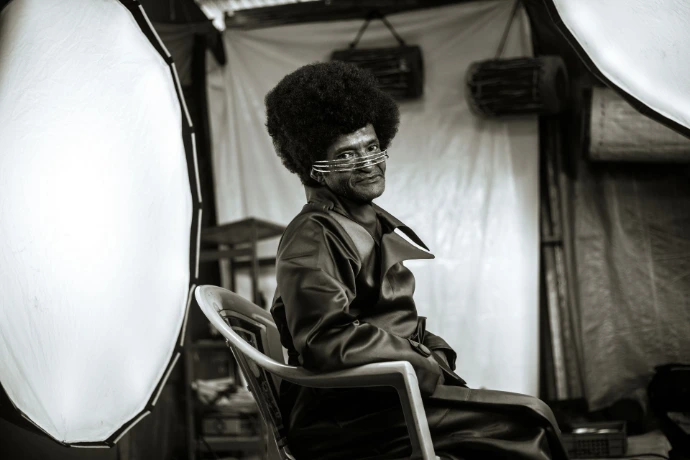
These seemingly incidental details can communicate emotion with a clarity that a carefully constructed pose cannot always achieve. Matheka is highly observant of these moments, watching for a particular quality in a wrinkle, a change in expression or a habitual gesture that can become part of the image.
It is a form of direction that is almost invisible.
Yet the portrait, as Matheka explains, is not necessarily an attempt to reveal the entire character of the person in front of his camera. It is ultimately about bringing the artistic vision to life.
“The people are the canvas.”
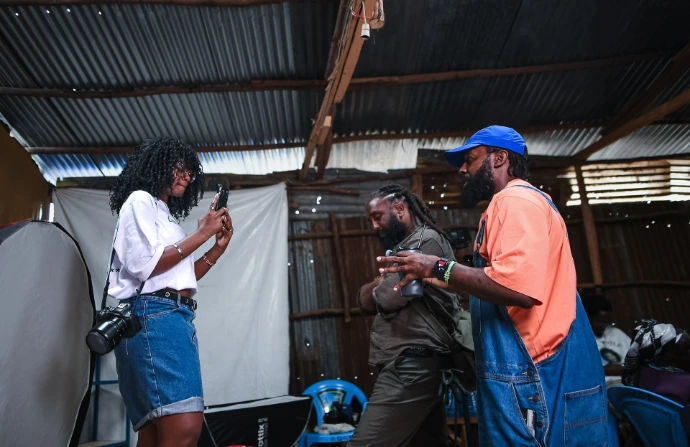
He compares the process to filmmaking. A script can establish a character, but when an actor inhabits that character convincingly, something changes. The role begins to belong to them.
Something similar happened during Akili ni Nywele.
Once the elders entered the visual world created for them, Matheka noticed that they seemed to change. They appeared bolder, more assured and, at times, almost like different people from those who had arrived on set.
Perhaps they were not becoming different people at all. The process seemed instead to bring forward something that was already there, something they may have forgotten, outgrown or simply never had the opportunity to express.
That transformation was not limited to the subjects. It also changed the way Matheka had to work.
He is accustomed to occupying a relatively peripheral position with his subjects, observing and directing without necessarily becoming deeply involved in the physical experience of the shoot. With elders, that distance had to disappear. The process demanded more listening, more patience and much greater attention to physical comfort.
There was often a very limited window in which a pose could be held before it became uncomfortable. A visually successful position could therefore not be pursued indefinitely. Matheka had to make quick decisions about angles, positioning and composition, often adjusting the image in real time.
The work became an exercise in instinct and constant adaptation.
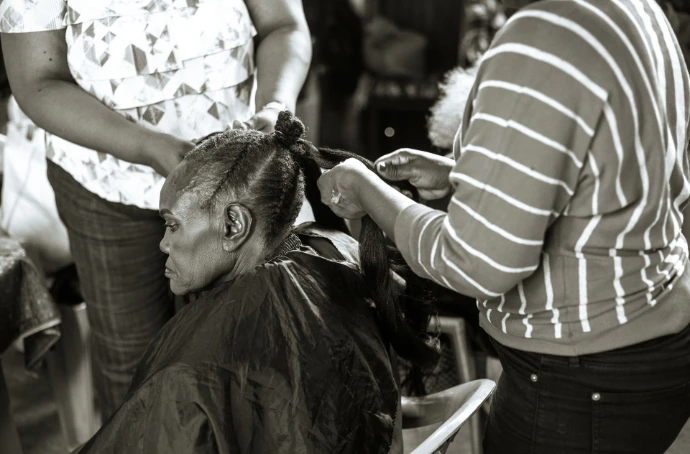
Sometimes those decisions were technical. Other times they were completely practical. At one point, a T-shirt had to be cut because the subject's hair had already been styled and the garment could no longer be removed in the usual way. The solution was candid and entirely whimsical.
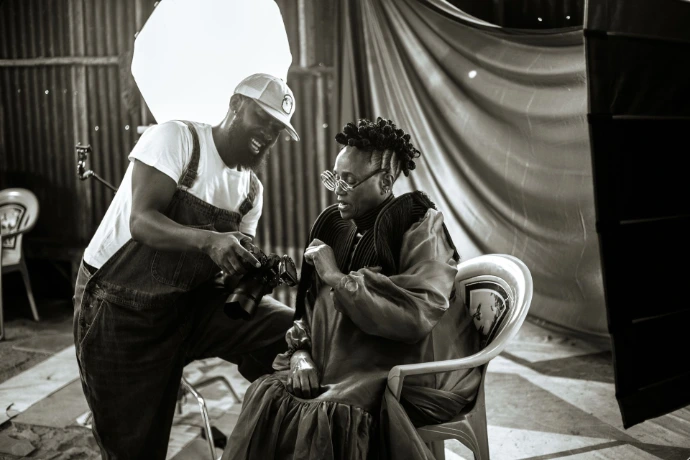
Such comical bloopers will never appear in the final photograph, but they are part of what produced it.
So are the conversations, the laughter and the interactions between the elders themselves. Matheka became increasingly attentive to the way they responded to one another, the moments when they lit up and the small behaviours that emerged when they were no longer conscious of the camera.
This is where the central idea behind Akili ni Nywele begins to emerge.
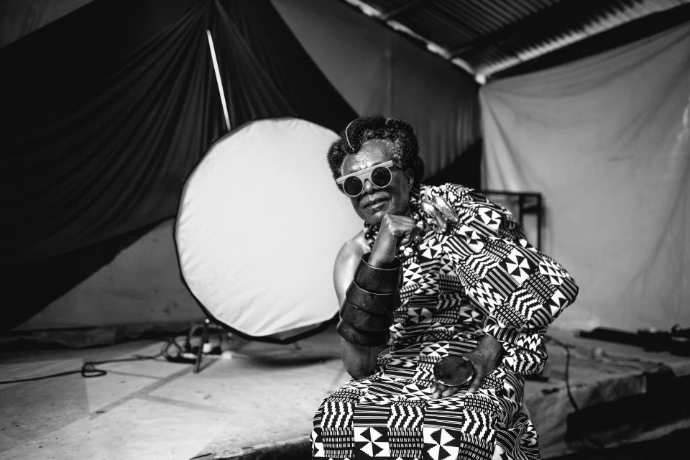
For Matheka, the project became a form of time travel.
Growing old is a privilege. Rather than treating age as something to be concealed or corrected, the camera becomes a way of observing what time has left behind.
The styling follows the same principle. It was not intended to make the subjects younger. It was intended to make them look their best as they are.
That distinction matters because contemporary ideas of beauty are frequently tied to youth. The visible effects of age can be treated as imperfections, things to minimise or remove. Akili ni Nywele asks what happens when we approach those same signs from another perspective.
A wrinkle can become a record of time.
A change in the body can become evidence of experience.
What appears at first to be physical decline can truthfully and simply be a sign of endurance, history and beauty.
Beauty, in this context, is not the absence of age. It is what age has made visible.
This perspective also changes the role of fashion within the work. The clothing, styling and visual construction are important, but they function as enhancers rather than the story itself. They create the environment in which the subjects can be seen differently, without attempting to erase the realities of their age.
And this brings Akili ni Nywele back to the larger purpose of Nywele.
Across African societies and generations, Hair has been connected to identity, social belonging, cultural expression and collective memory. It has also been shaped by histories in which it became a means of control and exclusion, before being reclaimed in many contexts as a symbol of pride, acceptance and self-love.
Hair can connect the individual to the communities that have been, are and will be.
For the elders in Akili ni Nywele, that relationship becomes particularly significant. They are not simply people being photographed with particular hairstyles. They are themselves carriers of memory.
The project therefore creates a dialogue between what has been inherited and what is being reimagined.
This is ultimately what makes Akili ni Nywele more than a series of portraits of older people. It is an exploration of what happens when we change the context in which we see them, and when we allow beauty to exist outside the familiar vocabulary of youth.
Within Nywele, it becomes one expression of a much larger conversation about African hair: where it has been, what it has represented, what it means now and what it might continue to mean for generations to come.
The hair is part of the story.
The people are the living archive.