
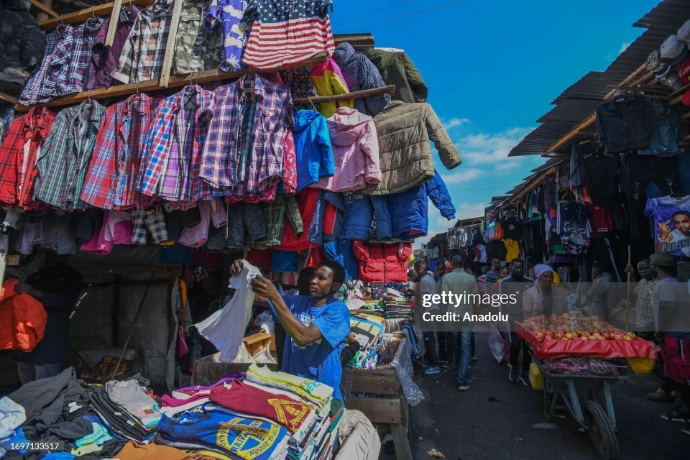
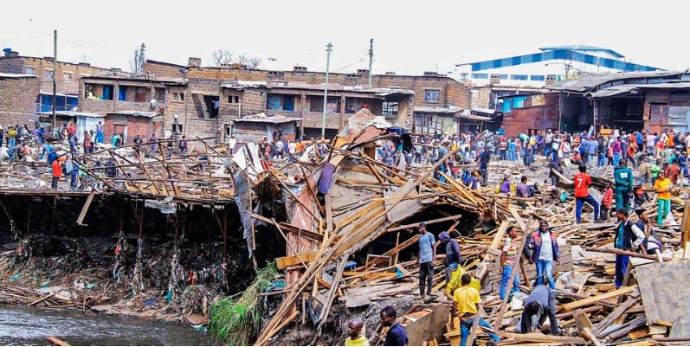
Traders at Gikomba Market woke up to partial demolitions carried out overnight into Tuesday, March 31, leaving many counting losses after their stalls were brought down following a 72 hour notice.
The demolitions are part of a broader plan to modernise the space, with the aim of reducing perennial flooding by upgrading infrastructure along the Nairobi River riparian corridor, lowering the risk of accidental fires through the use of less flammable materials, and improving waste management systems.
On paper, these objectives are sound. In practice, they only address part of the problem.
Gikomba is not simply a marketplace. It functions as a system. It is a supply chain hub, a startup ecosystem, an informal financial network, and a source of livelihood for thousands.
In stark terms, Gikomba also contributes significantly to the waste that ends up in the Nairobi River. Yet reducing it to an environmental liability overlooks its economic centrality.
This is where the intervention begins to fall short.
Modernisation alone is not a cure. Addressing the visible symptoms without engaging the underlying structure risks recreating the same vulnerabilities in a different form. While the government has promised to cover costs associated with the disruption, no concrete or enforceable guarantees have been extended to traders. Many of them operate on narrow margins, relying on informal credit systems, trust based supply chains, and short term loans.
The result is a state of uncertainty.
Relocation efforts remain unclear, and that uncertainty has created room for exploitation. Cartels, according to sources, are already taking advantage of the transition by inflating costs, extracting informal fees, and placing additional pressure on traders who are already financially strained.
For some, this moment signals the end of an era.
For others, it feels less like transformation and more like repetition, a familiar cycle of disruption presented as reform.
The real question is not whether Gikomba should change.
It is whether this version of change fully understands what Gikomba represents.