
In Kenya, the “Made in Kenya” label carries a subtle contradiction. It suggests clarity, yet in practice, it fractures into three distinct realities.
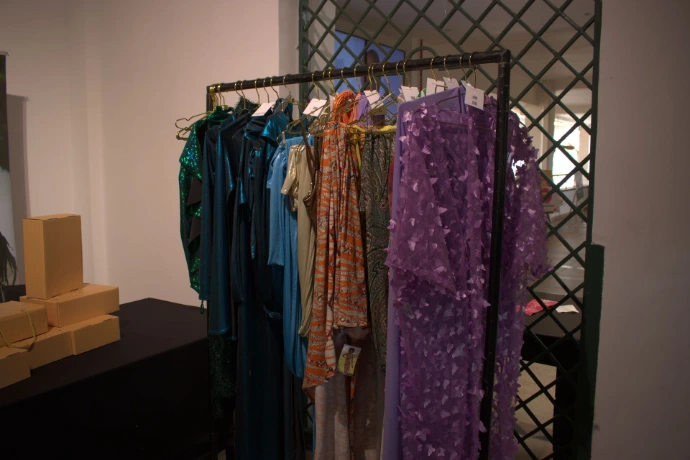
Garments made from Kenyan materials but manufactured abroad. Pieces produced locally using imported fabrics. And the ideal, fully Kenyan in both sourcing and production. These are not simply categories. They are signals of how the industry functions, where it struggles, and where it is quietly evolving.
The first model, Kenyan in origin but foreign in execution, reveals the clearest gap between creativity and infrastructure. Kenya produces cotton, leather, and a growing range of natural fibres, yet large-scale textile processing remains limited. Cotton is often exported raw or semi-processed, only to return as finished fabric at a higher cost. This circular dependency is not accidental. It reflects decades of underinvestment in textile mills, inconsistent policy support, and the collapse of once-functional manufacturing ecosystems.
For designers, especially those operating from the diaspora or scaling for volume, the decision to manufacture abroad is less about preference and more about predictability. Countries like China, Turkey, and India offer vertically integrated systems. Fabric sourcing, dyeing, finishing, and garment construction exist within a single chain. Lead times are shorter. Quality control is standardized. Cost, at scale, is lower.

Kenya, by contrast, operates in fragments. Artisans are skilled, but specialization is uneven. Industrial machinery is scarce or outdated. Technical finishing, the difference between a garment that feels local and one that competes globally, often requires additional training. Even basic inputs such as consistent dye lots, trims, or high-grade interfacing can be difficult to source reliably.
In that context, outsourcing is not an abandonment of local industry. It is a response to its incompleteness.
The second model, production in Kenya using foreign materials, speaks to aspiration and exposure. Designers who have engaged with global markets understand no fashion system is self-sufficient. Even the most established industries rely on importation to sustain innovation. The introduction of foreign textiles into Kenyan design is not dilution. It is dialogue.
Yet the imbalance is real. Imported fabrics arrive with a perceived superiority, often tied to finish, durability, or global recognition. Left unchecked, they can displace local textiles, not through intention but through demand. The risk is not cultural erasure. It is economic displacement. When local fabrics are underutilized, their production declines. When production declines, skills disappear. What remains is dependency.
And dependency, in fashion, is costly.
The third model, fully Kenyan in both material and execution, carries the weight of expectation. It is positioned as the most authentic expression of the industry, rooted in heritage and anchored in place. Nairobi stands at the centre of this ecosystem, functioning as both marketplace and cultural melting pot.
But authenticity does not exist outside economics. The core consumer base remains narrow. Purchasing power is concentrated among individuals whose wardrobes are shaped by function as much as taste. Professional settings, social ceremonies, and cultural expectations define what is worn. The result is a market that rewards refinement within established boundaries rather than radical departure.
Designers respond accordingly. Silhouettes become predictable. Innovation is incremental. Risk is calculated against sales.
Over time, repetition begins to erode distinction. When garments feel familiar to the point of redundancy, the consumer looks elsewhere. Not necessarily because foreign fashion is superior, but because it appears to offer variation. This is how local industries lose ground, not through lack of talent, but through constrained evolution.
Creativity, in Kenya, has not disappeared. It has been displaced.
It exists most visibly on the runway, in collections that are technically ambitious and conceptually expansive. Here, designers experiment with structure, material innovation, and narrative. There is evidence of engagement with global fashion systems.
But these collections operate within a different economy. They are expensive to produce and even more expensive to purchase. Their audience is limited. The younger consumer, often the most receptive to this level of experimentation, remains priced out.
This creates a fracture between visibility and accessibility. Kenyan fashion, at its most innovative, is seen but not worn.
At its core, the “Made in Kenya” conversation has been framed incorrectly. It has focused on authenticity as a measure of purity rather than capacity. The question is not how Kenyan a garment is, but how well the industry can sustain, scale, and evolve its own systems.
This requires more than creative excellence. It demands investment in textile processing, in technical training, in machinery, and in supply chain integration. It requires designers to move beyond survival-based decision-making and into long-term strategy. It requires consumers to engage with local fashion not only as culture, but as industry.
Most critically, it requires a shift in mindset.
Kenyan fabrics and techniques should not be treated as fixed symbols of identity. Nor should global materials be seen as threats. The future lies in synthesis. In allowing tradition to inform innovation without restricting it. In building a fashion system where culture operates as foundation, not limitation.
Because culture, when confined, becomes static.
And fashion, by nature, refuses to stand still.